



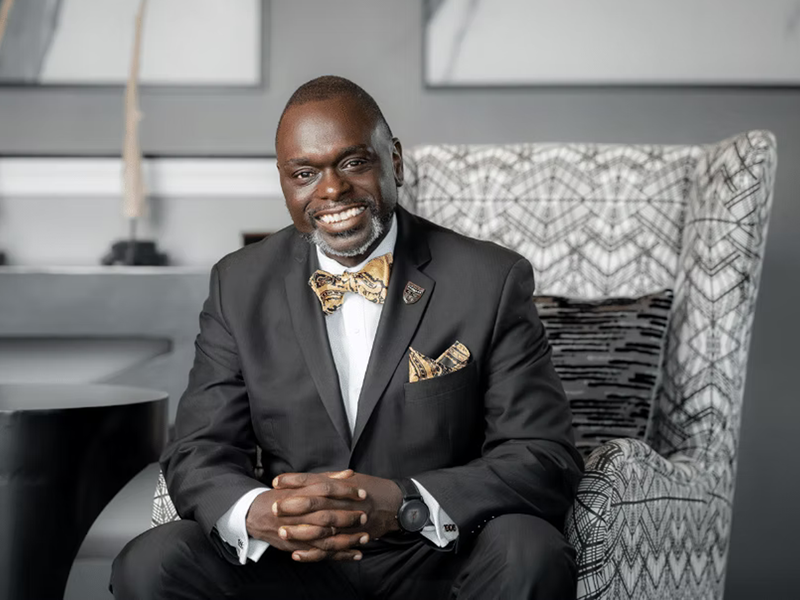
Alpha Phi Alpha’s 37th General President, Lucien J. Metellus, Jr., carries himself like a man who knows his many titles—but refuses to be confined by any of them. He is a husband, father, fraternity leader, technologist, minister, activist, and published poet, yet when asked who he is, he begins somewhere far deeper: “First, he’s a child of God.” From that foundation flows a life shaped by faith, family, and fraternity, and a vision for Black manhood that insists on complexity where society often settles for caricature.
Roots in Faith, Family, and the African Diaspora
Metellus was born in Brooklyn, New York, to a family of Haitian descent, later moving to Queens as a teenager and attending Springfield Gardens High School before earning a degree in Policy Studies from Syracuse University. In those formative years, he began to see himself not only as an individual but as part of the broader African diaspora, a Black man navigating America’s layered expectations and limitations.
He describes himself as “a child of God… an activist by nature, a poet, a husband, a son, a friend, a fraternity brother, a nephew,” emphasizing that no single label can contain the whole of who he is. For Metellus, identity is a “combination of history, historical relevance, people, and the things that shape me, which is my faith, my family, my friends, and my fraternity.” That multidimensional self-understanding undergirds his leadership and his insistence that Black men must be allowed—and encouraged—to live in more than one dimension at a time.
Redefining the Black Male Narrative
Metellus is acutely aware of the way media often flattens Black men into stereotypes, reducing their stories to one narrow script. He pushes back against this both in his personal life and in his role as president of Alpha Phi Alpha. “Even the African experience in America, being Black in America… we’re more complicated than our race,” he says. He refuses to assume that any one Black man’s life can be fully predicted by his race alone.
That conviction drives his passion for giving young men space to see and express themselves as complex people. He believes part of the work is simply modeling that complexity: advocating for women and the marginalized, mentoring youth, engaging in serious conversations about mental health, and still making time to enjoy a football game or root for the Knicks. Brotherhood, he insists, is a “contact sport” that requires actual presence, engagement, and care. Social media can play a role, but real brotherhood happens when men show up for one another and “impress upon” each other the need to do the same.
Called to the House of Alpha—and to Lead It
Ironically, Metellus never planned to join a fraternity. As a young man, he did not see Greek life as something that fit him—until someone else saw something in him and urged him to look into Alpha Phi Alpha. What ultimately drew him in was not just the organization’s storied history, but the brotherhood it offered to an only child hungry for community. He entered the fraternity through Zeta Zeta Lambda Chapter in St. Albans, New York, and began a journey of layered leadership.
Over the years, he has served as chapter President, Vice President, Secretary, Director of Educational Activities, Associate Editor to the Sphinx, fundraising chair, and advisor to the college chapter Theta Epsilon at St. John’s University. At the district level, he has taken on roles from Parliamentarian and Secretary to New York State President and District Director. He later served the Eastern Region as March for Babies Coordinator, Parliamentarian, and Director of College Brothers Affairs, eventually becoming a voting member of the Board of Directors as the 28th Eastern Regional Vice President.
His leadership extended beyond the fraternity’s internal structure into the broader Pan-Hellenic community. He has chaired Founders’ Day and Membership, and served as board member, Parliamentarian, Vice President, and President of the Pan-Hellenic Council of Greater New York—representing and coordinating among the nine historically Black fraternities and sororities that collectively serve dozens of chapters in the region. On January 12, 2024, that long arc of service culminated in his election as the 37th General President of Alpha Phi Alpha Fraternity, Inc., an office he assumed on January 1, 2025.
Leadership as Service, Not Status
For Metellus, leadership is not about personal elevation but about centering a collective mission. He defines leadership as “the ability to understand multiple personalities, not satisfy most of them, but still motivate them to the mission.” It is never about the leader’s ego; it is about what is best for the people and the organization they serve.
That is why he ran for General President—not to add another title to his résumé, but to give back to the brothers and communities who invested in him. He speaks with urgency about addressing educational inequity, expanding mental health conversations for Black men, and preparing communities to engage emerging technologies. His goal is to help shape “the next great set of Black men that the world has never seen in this generation,” whether or not they ever join a fraternity. The measure of his success, he says, will not be plaques or recognition, but whether “when I leave this world,” this generation’s Black men are stronger, more supported, and more fully equipped than the ones before.
Brotherhood, Misconceptions, and the Power of Mentoring
Metellus is candid about popular misconceptions surrounding Black fraternities. The first, he notes, is the idea that they are merely social clubs built around parties and stepping. For him, Alpha and its sister organizations are fundamentally about brotherhood and service to the community. The second misconception is that fraternities are somehow anti-Christian. He counters this directly, pointing to Alpha’s deep historical engagement with Christian values and to icons like Martin Luther King Jr., whose faith was inseparable from his Alpha identity.
Another misconception, he says, is that joining a fraternity means “paying for friends.” Dues and fees are investments in an organization that, in his experience, has given him far more in intangible growth—making him a better Christian, father, husband, and friend—than he could ever repay. That growth, he argues, is tied to the fraternity’s emphasis on mentoring. He believes mentorship must begin as early as kindergarten and continue in stages, because “the high school me was not the college me, was not the post-college me.” Mentoring is not only about careers; it is also about relationships, consent, navigating culture, and learning from those who have already walked the paths young men hope to travel.
Literacy, Technology, and a Life of Many Callings
For a man who describes himself as a poet and writer, it is no surprise that Metellus sees literacy as central to Black advancement. He recalls that Alpha itself began as a literary society and notes that its long-running Sphinx magazine is one of the oldest Black publications in the United States. But his understanding of literacy extends beyond reading books: it includes technological literacy, communication skills, and multilingual capacity. In a world shaped by artificial intelligence and rapid change, he argues, Black men must be literate across many platforms to thrive.
Professionally, Metellus has spent two decades in information technology as a Project Manager and Senior Business Analyst, managing projects that have saved businesses millions of dollars through strategic use of technology. He holds multiple certifications and degrees in leadership, project management, religion, and technology, reflecting a career at the intersection of systems, people, and purpose. Beyond his corporate work, he has volunteered with organizations such as the Center for Hope and Safety (a domestic violence shelter), Youth Partnership of Bergen County, March of Dimes, Boy Scouts, and Big Brothers Big Sisters of America. He serves as chair of the Diversity, Equity, and Inclusion committee in Frederick, Maryland, teaches Christian education to young adults, and has ministered in multiple churches—all while nurturing his own craft as a writer and poet.
Self-Care, Legacy, and the Next Generation
With so many responsibilities—General President, professional, minister, husband, father—Metellus admits that self-care is an area where he is still learning. His wife, he says with gratitude, is a “big advocate for self-care” who pushes him to rest and recharge. For him, self-care can look like watching sports, playing video games, writing, or simply taking a nap. Ultimately, he strives to keep his priorities in order: God, family, job, then fraternity, even though the demands of life sometimes blur those lines.
When asked what legacy he hopes to leave as president of Alpha Phi Alpha, his answer returns to the next generation. He wants this era to produce “the best group of Black men that have ever existed in this era,” men who become presidents, senators, inventors, Nobel laureates, and community builders. He is not concerned with whether his name is attached to their achievements; what matters is that his leadership, and the fraternity he serves, helped make their success possible. In that sense, Lucien J. Metellus, Jr. is not just leading Alpha Phi Alpha; he is laboring to expand what is imaginable for Black men everywhere—one act of brotherhood, one word of encouragement, and one young life at a time.